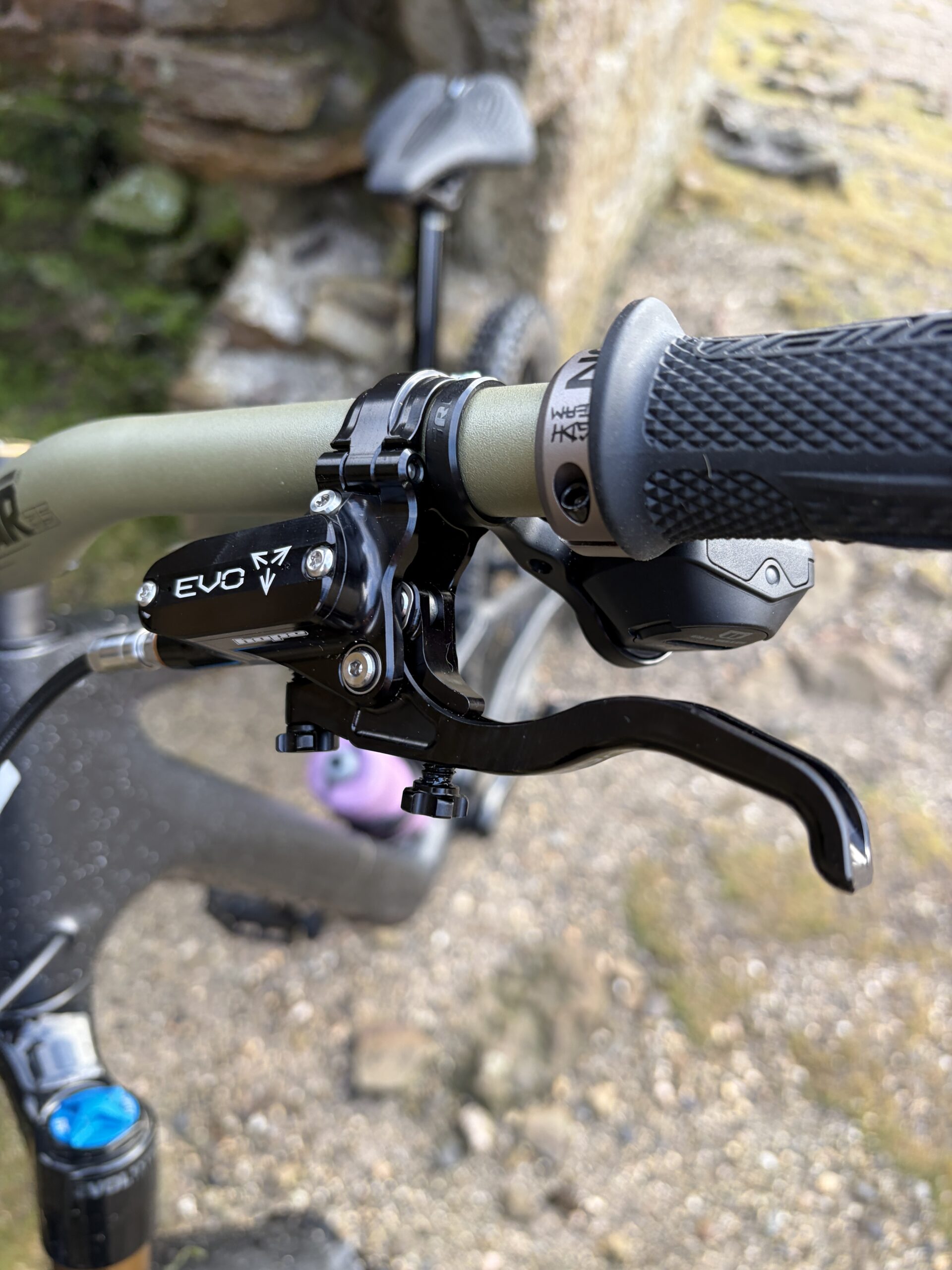
Built upon the foundation of the Tech 4 Hope EVO TR4 represents a refined evolution of an already successful platform. While the original Tech 4 set a high bar, Hope returned to the engineering phase to further optimise the system’s performance and ergonomics.
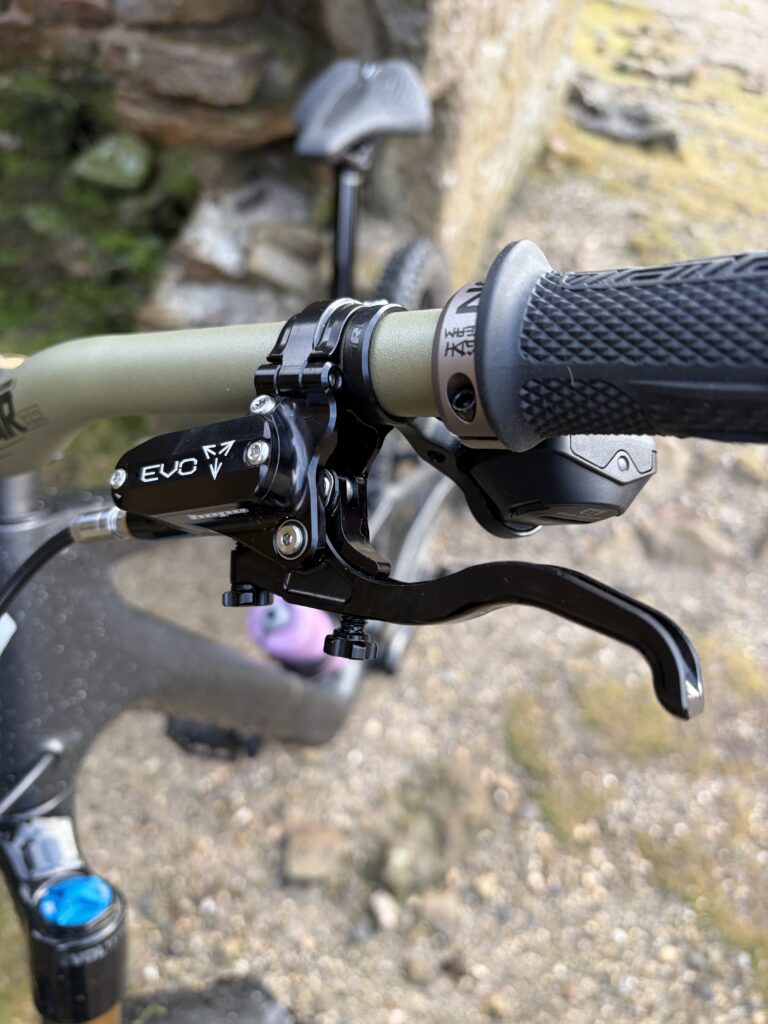
The EVO series maintains a modular approach, offering three distinct configurations tailored to cross-country, trail (TR4), and gravity disciplines (GR4). This is achieved by pairing a universal lever design with specialised, application-specific calipers.
Key Features and Design Updates
- Optimised Ergonomics: The most striking update is the revised lever blade. It features a more pronounced “hook” and a CNC-machined dimpled texture, both designed to enhance finger security and tactile control under demanding conditions. The lever blade can also be swapped out to give a different lever feel.
- Enhanced Actuation: The lever rotates on a high-quality roller bearing, ensuring a friction-free, smooth pull throughout the stroke.
- Refined Maintenance: Moving away from traditional reservoir-cap bleeding, the EVO lever now features an external bleed port. This allows for a simplified process similar to the Shimano system, where a bleed cup can be threaded directly into the port.
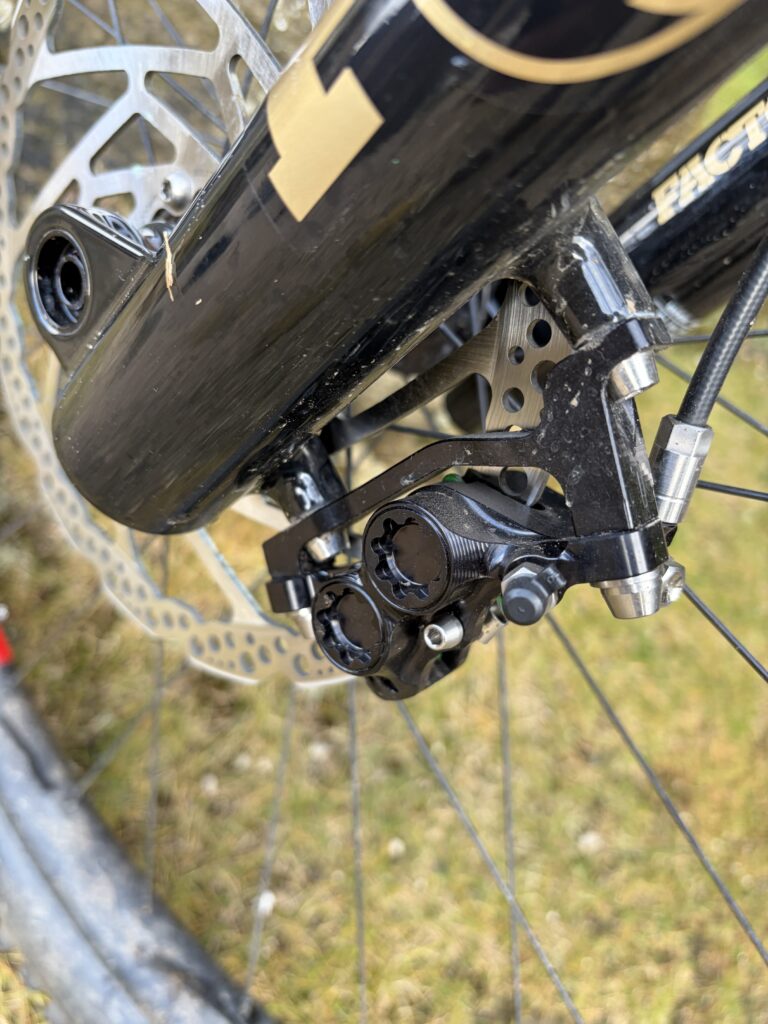
- Trail-Specific Performance: The TR4 variant utilizes a four-piston caliper. Positioned by Hope for “medium-duty” use, it is engineered to balance weight and power specifically for modern trail riding.
The EVO TR4 is a significant step forward in user-centered design. By adopting a more modern bleeding interface and focusing on the tactile interface of the lever, Hope has addressed common pain points while maintaining their reputation for “bombproof” CNC engineering. Having bleed both the front and rear TR4s I can confirm that the process was both easy and mess free with the Hope bleed kit. The official Hope bleed video was definitely worth a watch.
For the last few years my bikes have been fitted with SRAM Code brakes of one variety or another. The last two bikes have been fitted with the SRAM Code Stealth Ultimates. I moved away from the Hope Tech 3 system to the SRAM Code many years ago because of a compatibility issue between Industry 9 Torch hubs, Fox 36 forks and the Hope Tech 3 E4 caliper. I also didn’t enjoy the Hope bleeding system.
The Code Ultimate was (prior to the release of the Mavens) SRAM’s flagship heavy-duty brake, often found on everything from trail bikes to downhill rigs.
Comparison Overview
| Feature | Hope EVO TR4 | SRAM Code Ultimate |
| Intended Use | Trail / All-mountain | Trail/ Enduro / Downhill |
| Construction | CNC-machined T6 aluminum (UK) | Forged aluminum / Carbon lever blade |
| Fluid Type | DOT 5.1 | DOT 5.1 |
| Weight (approx.) | ~285g (Front, cut hose) | ~291g (Front, cut hose) |
| Braking Feel | Snappy but highly linear | Progressive “SwingLink” feel |
| Bleeding | Threaded cup | Bleeding Edge (dual syringe) |
The lever blade on the Hope EVO TR4 (and the wider EVO range) is one of the most significant tactile updates. While it maintains Hope’s signature CNC-machined aesthetic, the geometry and texture have been completely overhauled to improve ergonomic security and customisability.
1. Enhanced “Hook” and Ergonomics
The most visible change is the deeper, more pronounced hook at the end of the blade.
- The Benefit: This is designed to “lock” your finger into place. During aggressive riding or long, chattering descents, it prevents your finger from migrating outward or slipping off the end of the lever.
- The Feel: Reviewers note that this gives the brake a more secure, “wraparound” feel compared to the flatter profile of the older Tech 4.
2. New Dimple Texture
The face of the lever features a revised CNC-machined dimple pattern.
- The Benefit: Unlike a smooth or laser-etched surface, these physical indentations provide mechanical grip.
- Performance: This is particularly effective in wet or muddy conditions where gloves might lose traction on a standard metal surface. It also aids in heat dissipation and provides a distinct tactile “reference point” for your finger.
3. The “Three-Blade” System
For the first time, Hope has introduced three distinct lever blade options to cater to different hand sizes and reach preferences. While the “standard” blade comes on the brake, you can swap it for:
| Blade Type | Best For… | Key Difference |
| Standard | Most riders | A balanced middle ground for reach and leverage. |
| Power | Large hands / Max Leverage | 5mm longer than standard; designed for riders who run their levers far from the bar. The extra length adds mechanical leverage for more power. |
| Control | Small hands / Close Reach | 5mm shorter; optimized for riders who prefer the lever tucked in close to the grip. It adjusts the biomechanics to maintain a light feel even at a short reach. |
The EVO TR4 standard blade feels much more anatomical. It manages to be more comfortable for long days in the saddle while offering significantly more grip for technical, high-consequence braking. For my riding I see no need to try the other two blades.
4. Key Differences in Performance
i. Modulation vs. Progression
- Hope EVO TR4: Very linear feel. The amount of stopping power you get is directly proportional to how hard you squeeze. The new “EVO” cam system has reduced the free stroke, making the engagement feel more instant and “snappy” compared to older Hope models, but it remains predictable throughout the pull. With the 2.3mm solid Hope disc rotors there is little to no dead stroke. Power delivery is spot on.
- SRAM Code Ultimate: Uses SwingLink technology, which creates a more non-linear pull. It moves the pads quickly to the rotor at the start of the stroke, then increases leverage for more power at the end. This can feel more “powerful” at the limit but some riders may find it slightly less intuitive to modulate than the Hope.
ii. Ergonomics and Touchpoints
- Hope: The new EVO lever is heavily textured with updated CNC dimples and a deep hook. It feels “industrial” and mechanical. If you like the feel of precisely machined metal and a secure, non-slip surface, the Hope wins.
- SRAM: The Ultimate features a carbon lever blade and a smoother, more rounded profile. They are great if you don’t wear gloves.
iii. Maintenance and Durability
- Serviceability: Every single seal, screw, and piston is available widely as a spare part. The new threaded bleed port makes them as easy to maintain.
- Reliability: SRAM Codes have improved significantly over the years, but they can still occasionally suffer from “sticky pistons” over time.
iv. Internal Refinement (Roller Bearing & Cam)
Though not part of the “blade” itself, the way the lever blade moves on the EVO has changed:
- Roller Bearing Pivot: Carried over and refined from the Tech 4, the blade rotates on a precision bearing rather than a bushing, which eliminates the “stiction” found in cheaper brakes.
- Reduced Free Stroke: A new internal cam mechanism reduces the “dead band” (the distance the lever moves before the pads hit the rotor), making the engagement feel much more immediate and modern.
5. Bleeding and setup
The bleeding process was fairly easy to carry out. I purchased the Hope Tech bleed kit with the extension adapter for the cup to ensure that it would clear the reservoirs on the EVO Tech 4 levers. Using the same method as in the video above the process was mess free with little to no fluid waste.
Setting up the calliper and pistons was a little bit more involved. Although its wasn’t difficult. Hope do provide open source files on their website so you can print your own bleed block and other tools. I don’t have access to a 3-D printer so purchased a set via eBay. I would highly recommend getting hold of some if you can.
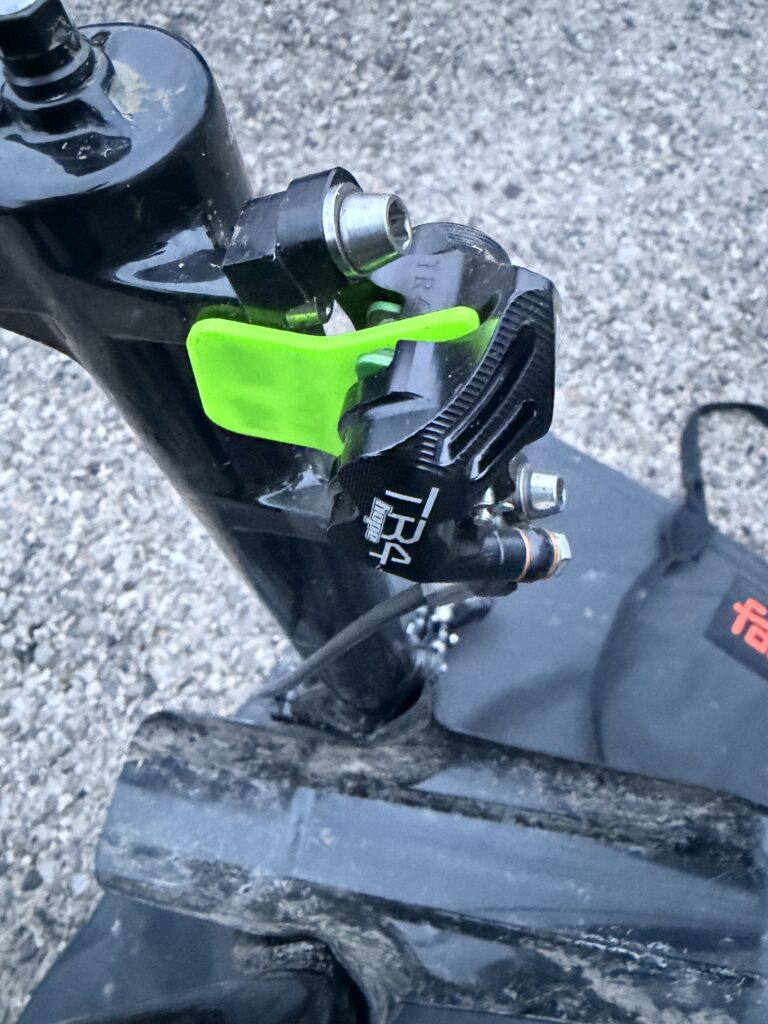
An issue I did have during setup was an initially sticky piston in the front calliper. I used the 3-D piston service block tool while I worked the offending piston out and then pushed it back home.
Getting the calipers centred is critical to the brakes working and feeling right. This is really emphasised within the video. Getting the calipers centred did take a couple of attempts to get right. I opted for the 2.3mm solid non-floating Hope rotors in the 200mm size. I did use the caliper alignment tool each time but needed to be careful when doing the bolts up as going in too heavy too soon would move the caliper very slightly.
So far so good. I’m pleased with the move to Hope and after a few rides now have the levers positioned where they need to be.
Leave a Reply